
Combining Ayurveda and Yoga for Holistic Healing
Two ancient sciences, one powerful path to complete well-being.
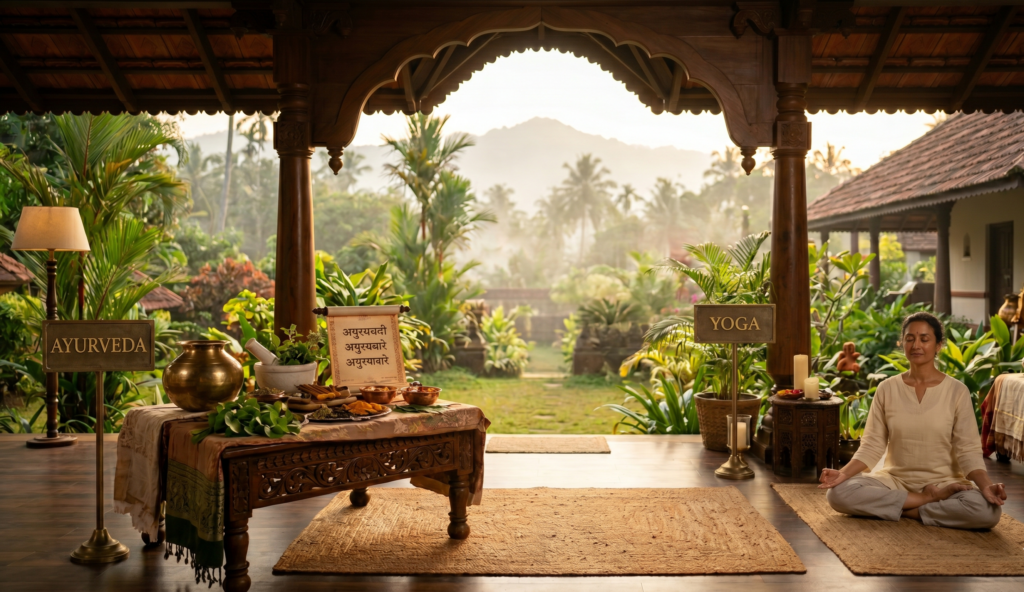
Imagine waking up each morning with a clear mind, a body that feels light, and an inner calm that carries you through the day. For thousands of years, people in India did not just imagine this — they lived it. The secret? Ayurveda and Yoga, two timeless sciences that were never meant to be practised separately. Together, they form one of the most complete systems of health and healing the world has ever known.
Two Ancient Sciences – One Purpose
Ayurveda and Yoga both emerged from the same ancient soil — the Vedic tradition of India. While Yoga focused on the journey of the mind toward stillness and liberation, Ayurveda turned its attention to the body and how to keep it in perfect harmony with nature. Yet both share a single, unwavering purpose: to help human beings live a life that is healthy, conscious, and meaningful.
Neither science was designed to be a quick fix. They are lifestyles — ways of seeing, eating, breathing, moving, and being. When you understand this, combining them stops feeling like a choice and starts feeling like the most natural thing in the world.
The Shared Origins of Yoga and Ayurveda
Both Yoga and Ayurveda trace their roots to the ancient Vedic scriptures, particularly the Atharva Veda and the Rigveda. The sages who compiled these texts understood that the human being is not just a physical body — we are a complex interplay of body, mind, breath, and consciousness.
Charaka, one of Ayurveda’s founding fathers, wrote extensively about the importance of mental discipline alongside physical health. Patanjali, who codified Yoga in his Yoga Sutras, acknowledged that a healthy body is the foundation of spiritual practice. They were, in many ways, writing about the same thing from different angles.
“The body is the temple of the soul. Ayurveda builds and maintains the temple. Yoga helps the soul find its way home.”
How Ayurveda and Yoga Help Each Other
Think of Ayurveda as the foundation and Yoga as the structure built upon it. Ayurveda tells you what your body needs — the right food, the right sleep, the right herbs, the right daily rhythm. Yoga gives you the tools to work with your body — the postures, the breath, the meditation.
Without Ayurveda, yoga practice can sometimes go wrong. A person with an already agitated mind (high Pitta) who does intense, heating yoga can end up more stressed, not less. Ayurveda steps in to say — slow down, cool down, this particular practice is not right for your constitution right now. Without Yoga, Ayurvedic treatments work only on the physical body and miss the deeper mental and emotional layers that so often drive our health issues.
Together, they do not just treat symptoms. They address the whole person.
Understanding Doshas in Yoga Practice
One of Ayurveda’s most profound contributions to yoga is the concept of the three doshas — Vata, Pitta, and Kapha. These are biological energies that govern every function in the body and mind. Each of us is born with a unique combination of these three doshas, and our yoga practice should ideally reflect that.
Vata (Air & Space): Creative but anxious. Needs grounding, slow, steady yoga like Yin or Hatha.
Pitta (Fire & Water): Focused but fiery. Benefits from cooling, calming practices like Moon Salutations.
Kapha (Earth & Water): Steady but slow. Thrives with energising, dynamic practices like Vinyasa or Ashtanga.
Practising yoga according to your dosha is not a restriction — it is a gift. It means your practice works with your nature, not against it, making every session more effective and more enjoyable.
The Role of Pranayama in Dosha Balance
This is the most critical decision you will make in this entire journey.
- Classical Credentials — The centre should have qualified Ayurvedic physicians — ideally BAMS and preferably MD (Ayurveda) — heading the clinical team. Ask directly about the qualifications of the doctor who will be treating you.
- Customisation Over Packages — Authentic Panchakarma is never a fixed package. If a centre is selling “14-day detox packages” with a fixed list of treatments regardless of who you are, be cautious. Your treatment should be designed around your constitution, your condition, and your goals.
- Reputation and Lineage — Look for centres with genuine lineage — those that have been practising classical Ayurveda for decades, or those affiliated with recognised Ayurvedic institutions. Patient testimonials and documented outcomes are positive indicators.
- Transparency in Formulations — The centre should be able to tell you exactly which medicated oils and preparations they use, and where they source them from. Classical formulations from reputable pharmacies are markers of seriousness.
- The Environment of Healing — Panchakarma requires rest, quiet, and simplicity. The ideal setting is calm, clean, and free of distractions. You should feel supported to rest, not pressured to socialise or sightsee.
- Post-Treatment Guidance — A responsible centre provides detailed Paschatkarma (post-treatment) dietary and lifestyle guidelines to maintain and build on the results of your Panchakarma.
What to Prepare Before Travelling
Breath as medicine
Pranayama — the science of breath control — is perhaps the most powerful meeting point between Yoga and Ayurveda. In Ayurveda, Prana (life force) is directly tied to Vata dosha. When the breath is disturbed, Vata goes out of balance, and anxiety, poor sleep, and scattered thinking follow close behind.
Which pranayama for which dosha?
Nadi Shodhana (alternate nostril breathing) is considered tri-doshic — it balances all three doshas and is safe for everyone. Sheetali (cooling breath) is specifically recommended for Pitta types, while Bhastrika (bellows breath) is excellent for Kapha types who need energising. Vata types do best with slow, deep, rhythmic breathing rather than intense techniques.
Even ten minutes of the right pranayama practice each morning can shift your entire day. It is that immediate, and that real.
Combining Yoga and Panchakarma
Panchakarma is Ayurveda’s most intensive detoxification therapy — a series of five cleansing procedures that remove deep-seated toxins (Ama) from the body’s tissues. What many people do not realise is that gentle Yoga is considered an essential companion to Panchakarma, not an optional add-on.
During Panchakarma, the body goes through significant changes. The digestive fire is intentionally lowered, the body is made more receptive, and toxins begin to move from the deeper tissues toward the digestive tract for elimination. Gentle yoga postures — particularly twists and forward folds — support this process by massaging the internal organs and encouraging lymphatic flow.
However, it is important that the yoga practiced during Panchakarma is mild and supervised. This is not the time for vigorous Vinyasa or hot yoga. The body is doing deep work, and it needs support, not challenge.
Benefits of Combining Both Systems
- Deeper, more targeted detoxification as Panchakarma and yoga work in synergy
- Better stress management — Ayurvedic herbs like Ashwagandha combined with pranayama dramatically reduce cortisol levels
- Improved digestion and gut health through yoga twists and Ayurvedic dietary principles
- Stronger immunity — both systems focus heavily on building Ojas, the body’s vital essence
- Better sleep quality through evening routines that combine both sciences
- Emotional balance — yoga clears the mind, Ayurveda nourishes the nervous system
- Sustainable weight management without extreme diets or exhausting workouts
- Slowing of the ageing process through Rasayana therapies and anti-ageing yoga practices
- A personalised approach — because both systems respect your individual constitution
Is This a Scientific Approach?
What modern research says
Sceptics sometimes wonder — is there actual science behind all of this, or is it just ancient belief? The answer is increasingly clear. Modern research has validated many of the claims that Ayurveda and Yoga have made for thousands of years. Studies published in the Journal of Ayurveda and Integrative Medicine have confirmed that Panchakarma significantly reduces inflammatory markers in the body. Research from Harvard Medical School has shown that yoga and meditation produce measurable changes in the brain — reducing the amygdala’s stress response and increasing grey matter density in areas associated with self-awareness and compassion.
The mind-body connection
Perhaps the most important scientific validation is the growing field of psychoneuroimmunology — the study of how the mind, nervous system, and immune system interact. This field has confirmed what Ayurveda and Yoga always said: that the mind directly affects the body’s ability to heal. Chronic stress suppresses immunity. Emotional trauma gets stored in the body’s tissues. Positive mental states genuinely accelerate physical healing. These are not beliefs. They are now documented scientific facts.
Ayurveda and Yoga were not primitive guesses. They were the result of thousands of years of careful, systematic observation of the human being in all dimensions.
Conclusion – True Holistic Healing
True holistic healing was never about treating a symptom or fixing a single part. It has always been about bringing the whole human being — body, mind, breath, and spirit — back into alignment with nature. That is exactly what happens when Ayurveda and Yoga work together. You stop chasing health and start living it. You stop managing stress and start dissolving the conditions that create it. You stop treating your body as something to be fixed and start experiencing it as something to be honoured.
The combination of Ayurveda and Yoga is not an alternative to modern medicine. It is a complement to it — a deeper, more complete way of understanding what it means to be well. And it has been waiting for you for five thousand years.
Begin Your Healing Journey with BookMyVeda
Authentic Ayurveda & Yoga — Personalised for You
At BookMyVeda, we connect you with India's most trusted Ayurvedic retreats and hospitals, offering authentic, personalized healing experiences rooted in classical Ayurveda.
Whether you're seeking detox, stress relief, or complete rejuvenation, we guide you every step of your wellness journey.
"Your healing is not a destination. It is a way of living."