

Chronic back pain is one of the most frequent and debilitating health issues affecting millions worldwide. While modern medicine offers treatments ranging from painkillers to surgery, many are turning to Ayurveda for lasting, root-cause relief.
Understanding Back Pain Through Ayurveda
In Ayurveda, persistent back discomfort is typically caused by an imbalance within Vata Dosha - the energy that drives motion and dryness. When Vata becomes aggravated, it results in stiffness, pain, and dryness in the joints and tissues.
Vata Dosha
Aggravated by cold, dry weather, stress, or poor nutrition. Causes Kati Shoola (lower back pain) and is the primary driver of Gridhrasi (sciatica).
Ama (Toxic Build-up)
Accumulation of metabolic toxins in tissues and joints, blocking the body's natural channels (srotas), generated by poor digestion.
Sandhivata
Osteoarthritis with cartilage loss and joint destruction, worsening progressively without treatment.
Ayurvedic therapy aims to soothe aggravated Vata, remove Ama, nourish the tissues and restore mobility - providing lasting, real relief, not just concealing symptoms.
The 6 Core Ayurvedic Therapies for Back Pain
1. Janu Basti - Warm Oil Pool Therapy
Warm medicated oil is held over the affected joint inside a dam made of black gram dough for 30-45 minutes, slowly penetrating the tissues. Reduces stiffness and swelling, lubricates cartilage, and is particularly effective for osteoarthritis and degenerative disc disease.
2. Abhyanga - Full-Body Medicated Oil Massage
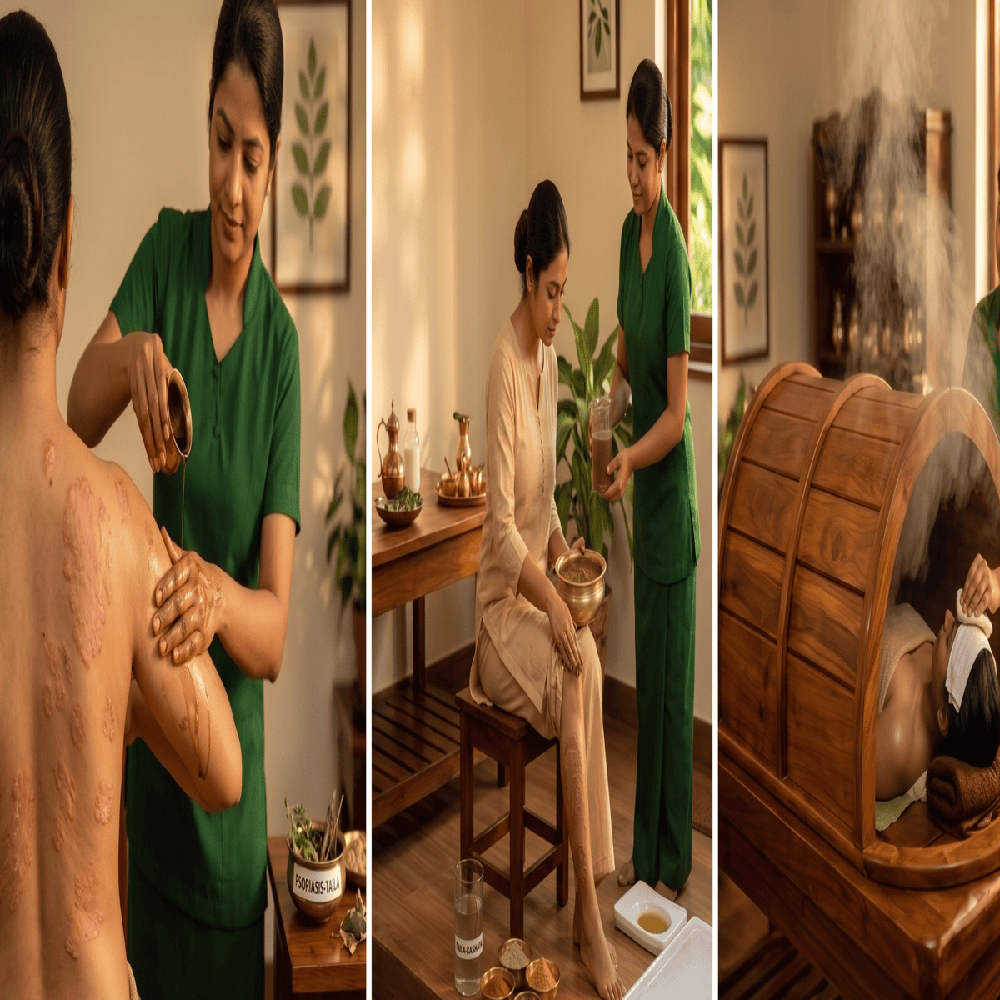
The primary pillar of Ayurvedic body care. Warm medicated oils are applied in long, synchronised strokes stimulating marma points along the back and spine, followed by a herbal steam bath. Improves circulation, relaxes muscle spasms, and detoxifies tissues by releasing deep-seated Ama.
3. Patra Pinda Sweda (Elakizhi) - Herbal Poultice Fomentation
Fresh medicinal leaves are cooked in medicated oil and tied into boluses, then systematically stamped over the muscles of the back and joints across 7-14 day courses. Reduces pain and inflammation, softens stiff muscles, and eases sciatica.
4. Pizhichil - The Royal Oil Bath
Often called the "king of Ayurvedic therapies" - warm medicated oil is poured in a steady stream by two to four therapists over 60-90 minute sessions across a 7-21 day course. Highly effective for arthritis and deeply nourishes nerve, muscle, and bone tissue.
5. Vasti (Medicated Enema) - Master Vata Therapy
Widely recognised as the most efficient Ayurvedic treatment for Vata-related conditions. Anuvasana Vasti uses medicated oils, Niruha Vasti is decoction-based, and Kati Vasti is localised oil retention for the lumbar region. Important: Vasti must only be administered by a certified Vaidya and is contraindicated during pregnancy, bleeding disorders, and acute infections.
6. Lepam - Medicated Herbal Paste Application
Herbs like Shallaki, Dashmoola, Rasna, and Nirgundi are ground into a paste, spread over the affected area for 30-45 minutes, followed by a hot herbal steam bath. Reduces swelling and pain, and promotes tissue healing with very few side effects.
Ayurvedic Herbs & Internal Medicines
Shallaki (Boswellia)
Potent anti-inflammatory that reduces joint pain and improves mobility, clinically validated in multiple trials.
Ashwagandha
Adaptogenic root that nourishes nerve and muscle tissue and reduces cortisol, the stress hormone that amplifies pain perception.
Guggulu
Powerfully detoxifying resin that breaks down Ama within joints, especially in the classical Yogaraja Guggulu formulation.
Rasna
Classical Vata-pacifying herb used to treat sciatica, joint pain, and rheumatism.
Nirgundi
Analgesic and anti-inflammatory herb used both internally and topically.
Dashmoola
Classical combination of ten roots that pacifies Vata and alleviates musculoskeletal pain.
Ayurvedic Diet & Lifestyle Guidance
Treatments alone are not enough - lasting relief demands steady changes in daily life.
- Avoid: cold, raw, dry foods, carbonated beverages, skipping meals, cold exposure, and prolonged sitting without movement breaks.
- Include: warm, well-cooked foods, ghee, sesame seeds, warm milk, ginger, turmeric, garlic, and regular meal times.
- Practise gentle yoga poses like Balasana, Setu Bandhasana, and Pawanmuktasana daily, and Nadi Shodhana pranayama to soothe the nervous system.
What Does Modern Research Say?
- Boswellia (Shallaki) is proven in numerous controlled trials to significantly decrease discomfort and improve function in osteoarthritis patients.
- Research on Abhyanga massage has shown measurable reductions in cortisol and blood pressure.
- Medicated enemas (Vasti) have been studied in clinical trials for lumbar spondylosis, showing significant improvements in mobility.
- Research on Patra Pinda Sweda confirms its effectiveness in reducing inflammatory markers.
When to Seek Ayurvedic Treatment
- Chronic back pain lasting more than 3 months with no response to conventional treatment.
- Osteoarthritis with joint stiffness, cracking, and degeneration.
- Lumbar spondylosis or disc prolapse under conservative management.
- Sciatica - nerve pain radiating down the leg.
- Desire to reduce or eliminate long-term dependency on pain medications.
Conclusion: Chronic Pain Needs a Deeper Solution
Chronic back pain is not simply a mechanical issue - it is a complex condition rooted in imbalance, inflammation, and degeneration that affects the whole person. Through Abhyanga, Elakizhi, Pizhichil, and Janu Basti combined with internal medicine and personalised lifestyle guidance, Ayurveda offers what modern medicine often cannot: true restoration, not just symptom management.
When diet is wrong, medicine is of no use. When diet is correct, medicine is of no need. - Ancient Ayurvedic Proverb